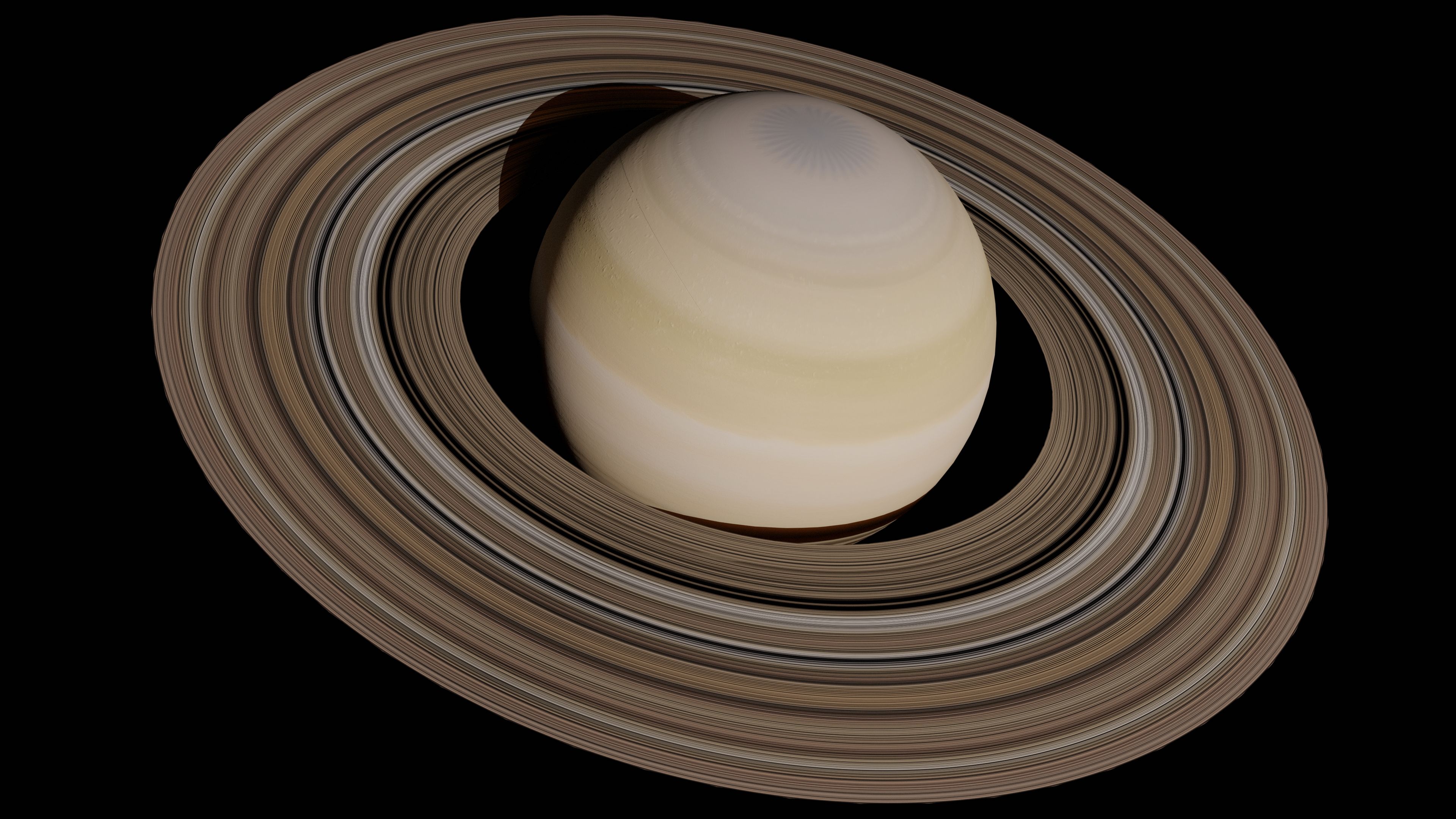
Title: Procedural Grandeur: Recreating Adrian, the Gas Giant from Project Hail Mary, in Blender Without AI
In the annals of science fiction cinema and the render farm, certain moments crystallize a particular kind of ambition: a blend of technical prowess, creative storytelling, and the stubborn insistence that a concept can become tangible through careful craft. The Reddit post about re-creating Adrian—the gas giant from Project Hail Mary—100% procedurally in Blender, without the crutch of AI, is precisely one of those moments. It’s not merely about a planetary model; it’s a case study in disciplined problem-solving, the art of translating fiction into convincing visuals, and the broader questions of how modern tools shape our ability to render imagined worlds.
What the project set out to achieve—and why it matters
At its core, Adrian represents more than a pretty surface. In Project Hail Mary, a gas giant serves as a stage for narrative tension, meteorology-like dynamics, and a sense of awe at the scales of the cosmos. Translating such a creature into a 3D scene requires balancing two complementary imperatives:
- Visual authenticity: The planet must look right—its bands, storms, and atmospheric texture must feel both real and artistically convincing.
- Generative fidelity: The process must be procedural, or at least heavily automated, so the result isn’t the product of a single artist’s hand painting texture maps but a reproducible system that can be tweaked, iterated, and documented.
The author’s decision to eschew AI in favor of procedural methods aligns with a broader discourse in digital art: the quest for reproducibility, explainability, and a deeper orchestration of the underlying mathematics. By leaning into procedural shading, noise functions, and Blender’s nodal workflows, the project becomes a blueprint for artists who want to push the boundaries of what software can do without outsourcing the creativity to pre-trained models.
From challenge to technique: the core hurdles and how they were addressed
1) The elusive curl: generating convincing atmospheric turbulence
– The author identifies Curl noise as a difficult target in Blender, acknowledging that other software platforms have made the effect more approachable. Curl noise, in particular, is valued for producing swirling, vortex-like patterns that resemble atmospheric eddies and long-lived storms on gas giants.
– The breakthrough comes not from a single trick but from synthesizing established procedural techniques into a robust shader or texture system. In practice, this means layering velocity fields, vorticity, and multi-scale noise, then remapping them through carefully tuned color ramps and contrast to simulate legitimate atmospheric dynamics.
– The takeaway for practitioners: when you’re aiming for large-scale, turbulent surfaces, temperatures of the texture space (such as frequency and amplitude ranges) must be tuned to mimic how gas giants interleave jet streams with chaotic vortices. Procedural texture design should embrace a hierarchy of scales—macro bands for latitudinal structure, then mid- to micro-scale perturbations to suggest turbulence.
2) The geometry: a convincing spherical shell with depth
– A gas giant is not a flat texture on a sphere. The illusion of depth comes from a combination of albedo variation, limb shading, atmosphere scattering, and subtle limb darkening. Procedural shading excels here because you can link color, transparency, and scattering parameters to a function of depth and viewing angle.
– The practical craft involves: (a) generating a smooth, high-resolution sphere; (b) applying a layered material that uses Fresnel reflections for the limb; (c) adding a volumetric or gradient-based atmospheric layer that accentuates depth without breaking performance.
– For readers: consider a multi-layer material stack where an outer atmospheric layer is connected to angle-dependent shading, and an inner sub-surface color field provides the illusion of volume beneath a thick veil of gases.
3) Motion and stillness: conveying a dynamic, living world in a static render
– A truly convincing gas giant often benefits from subtle animation—wind-driven band drift, storm rotation, or parallax cues—so a still frame can carry a sense of motion, or a sequence can reveal the planet’s personality over time.
– Procedural approaches help here too: you can drive cloud texture coordinates with time-based noise shifts, or feed the curl-inspired field into a dynamic texture that slowly evolves. Importantly, the workflow should maintain a balance between realism and render efficiency, especially if the final deliverable is a video sequence.
4) No AI, but with artistry: the role of artistry in a procedural workflow
– Procedural methods do not eliminate the artist; they empower precision and iteration. The Reddit creator’s emphasis on a tutorial video underscores a crucial point: the knowledge transfer from technique to practice is where real value lies.
– For practitioners, procedural depth is best learned through experimentation with parameter spaces, accompanied by explanations of why a given node arrangement yields a particular visual outcome. The art becomes a conversation between math and perception.
What makes this approach resilient in a changing landscape
- Reproducibility and scalability: Procedural methods can be re-shot, re-tuned, or repurposed for other planets or atmospheric scales without rebuilding textures from scratch.
- Hardware-aware workflows: As reliability and performance improve, artists can push higher resolutions, longer sequences, or more complex atmospheres without surrendering control to guesswork.
- Educational value: A well-documented procedural workflow—especially one with a tutorial narrative—serves as a learning scaffold for the next generation of digital artists who want to understand not just “what” but “why” a technique works.
A practical blueprint: translating the beats of the project into transferable practice
If you’re looking to apply the insights from this project, here is a distilled, practitioner-friendly roadmap:
1) Start with the blend of scale and structure
– Build a high-resolution sphere and establish broad latitudinal bands using procedural masks.
– Use a primary color gradient that mirrors the hue range you expect from a gas giant, then layer secondary bands with slight offsets to simulate differential rotation.
2) Engineer the atmosphere with layered noise
– Implement multi-octave noise to simulate large-scale turbulence, then modulate with curl-like fields to approximate vortices and eddies.
– Separate bands and storms into their own shader channels, enabling independent control over color, intensity, and opacity for each feature.
3) Simulate depth and lighting
– Introduce a depth-driven shading model: diffuse radiosity plus a subtle volumetric light component that darkens toward the limb, imitating how thick atmosphere would scatter and absorb light.
– Apply a shadowing pass or a directional light to accentuate the planet’s curvature, but ensure the shading remains gentle enough to maintain the sense of a gas giant’s enveloping atmosphere.
4) Animate with intention (if you choose)
– If motion is part of the deliverable, drive texture coordinates with a slow time offset and couple it with a wind-field proxy that subtly drifts the bands.
– Keep the motion coherent with the planet’s own rotation; avoid jarring, non-physical shifts that break immersion.
5) Document for transferability
– Create a project file structure that clearly separates geometry, shading, textures, and animation. Annotate the purpose of each node group and parameter.
– Produce a companion guide or quick-start checklist to enable colleagues or students to reproduce and adapt the results to other planetary bodies.
What this project signals about the current frontier in 3D artistry
- The role of proceduralism as a living craft rather than a cold set of recipes: The appeal of a 100% procedural Adrian is not only visual fidelity but the promise of a system that can be reconfigured for other worlds with minimal rework.
- The democratization and discipline of tool use: Blender remains a versatile platform that supports both artisanal handcraft and rigorous system-building. The tension between “no AI” and the desire for rapid iteration highlights a growing appreciation for human-guided procedural design.
- The storytelling power of visuals grounded in mathematics: When atmospheric phenomena are rooted in repeatable, explainable algorithms, viewers gain a sense that the world is consistent, discoverable, and believable—an essential ingredient for immersive sci-fi aesthetics.
Real-world relevance and broader implications
- In film, game development, and visualization, the ability to generate large-scale atmospheric phenomena procedurally reduces production risk and opens up more scenes that were previously constrained by manual texture painting.
- For educators and researchers, procedural methodologies offer accessible demonstrations of atmospheric physics and turbulence, enabling students to experiment with variables and observe emergent behavior without resorting to expensive, bespoke software.
A closing reflection: why this matters beyond the screen
The fascination with Adrian, the gas giant, extends beyond its cinematic appeal. It embodies a philosophy of digital creation that many practitioners are beginning to embrace: that the most compelling virtual worlds are not merely records of what artists can paint, but systems that reveal how those worlds work. The Reddit project, in its insistence on procedural integrity and explained craft, becomes more than a tutorial. It is a manifesto for modern visual storytelling—where mathematics, artistry, and accessible tools converge to widen the realm of what we can imagine and render.
If you’re drawn to this approach, engage with the underlying principles, experiment with the parameter spaces, and document your results. The universe is full of gas giants waiting to be rendered—and with procedural technique as your compass, you can chart them with confidence, reproducibility, and creative flair.