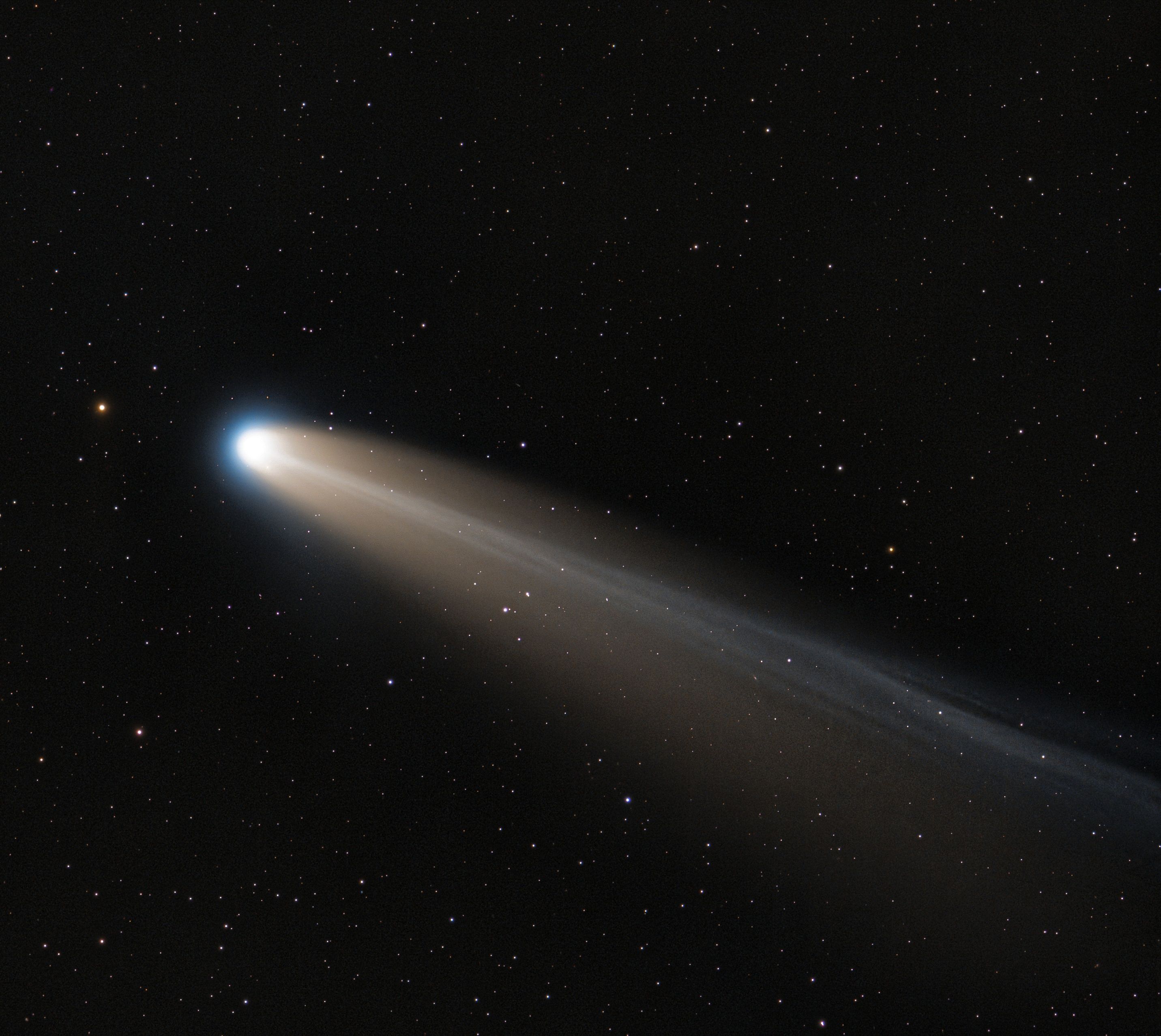
Title: The Quiet Architecture of Awe: Remembering Alan Hale, Co-Discoverer of Hale-Bopp
In the annals of modern astronomy, some celestial events become markers not only of scientific achievement but of cultural resonance. They reshape how a generation looks up, how communities gather under a shared sky, and how the patient craft of observation translates into public wonder. The death of Alan Hale, as announced by his wife Vickie on June 6, 2026, invites more than a memorial obituary. It offers an opportunity to reflect on the delicate intersection of perseverance, collaboration, and the stubborn mysteries that continue to animate amateur and professional stargazers alike. Hale’s name is forever entwined with comet C/1995 O1, better known as Hale-Bopp, a comet that arrived with extraordinary visibility and a surprising breadth of impact. But to understand why Hale-Bopp mattered, one must look beyond the spectacular tail and into the quiet, stubborn discipline that underpins great discoveries.
A lifetime of patient looking
Comet hunting is among the oldest forms of citizen science, yet it remains one of the most exacting disciplines in astronomy. It demands not only curiosity but a particular temperament: an eye trained to notice subtle deviations, a calendar crowded with long nights, and a collaborative mindset that appreciates the value of shared data. Alan Hale’s career embodies these traits. He did not come to fame through a single flash of insight alone; rather, he sustained an enduring commitment to observing, recording, and sharing his findings with a scientific community that thrives on reproducibility and openness.
Hale-Bopp’s ascent into public consciousness was unusual in scale. In the late 1990s, the comet offered a sweeping spectacle—an unusually bright nucleus, dense and extended tails, and a level of visibility that made it a communal event across continents. Yet behind that spectacle lay the slower narrative: the daily routines of astronomers who logged positions, refined orbital calculations, and collaborated across borders with other observers. Hale, alongside his co-discoverer (a collaboration that itself embodies the spirit of distributed discovery), demonstrated the enduring truth that major astronomical breakthroughs rarely arrive from solitary eureka but from sustained, patient accumulation of data, cross-checking, and the willingness to publish and verify.
The discovery that changed the conversation about comets
Hale-Bopp did not merely brighten the night sky; it altered the public’s understanding of comets as complex, dynamic objects with histories that could be traced and studied. It catalyzed discussions about the differences between long-period comets and their short-period cousins, about the composition of cometary nuclei, and about the potential for future science outreach when a spectacle awakens broad curiosity. For the professional community, it offered a testbed for refining methods of comet discovery, orbit determination, and photometric analysis—procedures that continue to power contemporary surveys and citizen science initiatives alike.
But what makes Hale’s contribution distinct is less about the meteorological specifics of a single comet and more about the ethos that produced the discovery. The Hale-Bopp event underscored a maxim that resonates beyond astronomy: significant observational breakthroughs often emerge when dedicated individuals maintain a rigorous, reproducible practice of data collection and share it in a way that invites peer scrutiny and collaboration. In an era when data streams multiply and the volume of information threatens to overwhelm, the Hale-Bopp story remains a reminder of the power of disciplined, methodical work—paired with openness to others’ observations.
Contextualizing the moment in the history of comet science
To appreciate Hale-Bopp’s significance, it helps to situate it in the broader arc of cometary science. The 20th century, and the early decades of the 21st, saw remarkable advances in our ability to track, predict, and characterize comets. Space-based observatories began to complement ground-based effort, enabling measurements across wavelengths and offering insights into volatile compositions, outgassing rates, and nucleus structure. Yet for much of their history, comets have been adversaries of certainty: unpredictable outbursts, fragmentation events, and evolving orbits remind us that comets remain both time machines—carrying records of the early solar system—and dynamic actors, continually reshaped by solar radiation and gravitational interactions.
Hale-Bopp stood out in two crucial respects. First, its reach transcended scientific audiences; it sparked widespread public interest and inspired a new generation of amateur observers to engage with real-time data, coordinate observations, and participate in citizen-science networks. Second, the comet presented a robust, well-documented dataset: long-duration monitoring, high-quality imaging, and a level of international collaboration that allowed researchers to assemble a coherent, richly detailed portrait of the object. In this sense, Hale-Bopp did not simply deliver a striking visual; it became a case study in how credible, collaborative observation can transform a singular event into a lasting contribution to science.
From discovery to cultural resonance: a broader reflection
The ripples of Hale-Bopp’s appearance extended beyond astronomy journals and conference rooms. It entered popular culture in a way few scientific phenomena do, becoming a shared landmark for people who may not have previously followed celestial events. This is not merely a matter of aesthetic delight; it reflects a deeper social capability—the possibility that scientific wonder can-thread communities, schools, and families into steady engagement with the night sky. In an age where attention is fractured across screens and immediate gratification, such moments anchor a more durable public appreciation for science.
Alan Hale’s legacy, therefore, is a reminder of how individuals can shepherd curiosity into durable practice. It’s a blueprint for how intense personal dedication, when combined with collaborative openness and rigorous methodology, yields outcomes that outlast the moment of spectacle. In the best sense, Hale’s work embodies a professional humility: a recognition that one’s most meaningful contributions arise from a network of observers, instruments, and institutions rather than from a solitary leap of genius.
Practical wisdom drawn from a life in observational astronomy
-
Cultivate a disciplined observational routine: The reliability of long-period comets hinges on consistent data collection over years or decades. A robust habit—recording precise times, coordinates, and observational conditions—creates a verifiable archive that others can build upon.
-
Embrace collaboration as a strength, not a distraction: The complexity of modern celestial events often requires cross-institutional cooperation. Sharing data, methodologies, and uncertainties invites scrutiny that strengthens conclusions and expands what is knowable.
-
Balance spectacle with rigor: Public engagement around celestial events is valuable, but it should be matched with careful communication about what is known, what remains uncertain, and how observations are translated into models and predictions. Clarity about uncertainty is not a weakness; it’s a sign of mature science.
-
Leverage community-powered validation: In an era of fast information, citizen scientists can be pivotal in time-sensitive observations. Providing accessible tools, clear reporting standards, and channels for feedback can harness a broader, more diverse base of contributors.
-
Document the process, not just the result: The value of a discovery lies as much in the method as in the finding. Detailed logs, calibration notes, and transparent analyses enable the next generation to replicate and extend the work.
What the future holds for comet science and public engagement
Looking ahead, the trajectory of cometary science will be shaped by both technological progress and cultural shifts in how science is conducted and consumed. Upcoming surveys and space missions promise more systematic surveillance of the outer solar system, increasing the likelihood of early detection and rapid follow-up. Artificial intelligence and machine learning will streamline pattern recognition in vast image archives, enabling observers to sift through petabytes of data to identify transient phenomena that merit closer study. Yet the human element remains indispensable: the curiosity, judgment, and collaborative spirit that people like Alan Hale embodied.
Public-facing science, too, will evolve. The Hale-Bopp moment teaches that spectacular events can serve as catalysts for lifelong engagement with science when communicated with honesty, excitement, and respect for the audience’s intelligence. The challenge for institutions—nurturing both the rigor of professional research and the accessibility of public storytelling—is to maintain that equilibrium as the pace of discovery accelerates.
A final reflection: remembering with care
Alan Hale’s passing marks the end of a chapter, but it also invites a broader meditation on what it means to observe, to contribute, and to be part of a collective pursuit larger than any one individual. For those who watched Hale-Bopp illuminate the sky with astonishing clarity, the memory is not just the image of a brilliant comet but a reminder of the patient craft that makes such moments possible: the quiet hours spent under dark skies, the meticulous habit of recording and sharing, and the communal ethic that welcomes others into the pursuit of knowledge.
As we remember Hale, we should celebrate not only the discovery itself but the ethos that made it possible. In a world where attention is constantly diverted by rapid news cycles and instant gratification, the Hale-Bopp story offers a corrective: a narrative about concentration, collaboration, and the enduring value of looking up. The night sky remains a vast, open laboratory, and the legacy of Alan Hale invites us to treat it with the seriousness it deserves—and, crucially, with the sense of wonder that first drew generations to the telescope.
If you are new to this story, consider starting with your own stargazing plans: a simple, patient commitment to watchful observation, a notebook or digital log for recording positions and conditions, and a willingness to share your findings with a broader community. The cosmos rewards the steady observer, and the best legacies—like Hale’s—are built not on solitary flashes but on the quiet, enduring practice of looking, learning, and collaborating.