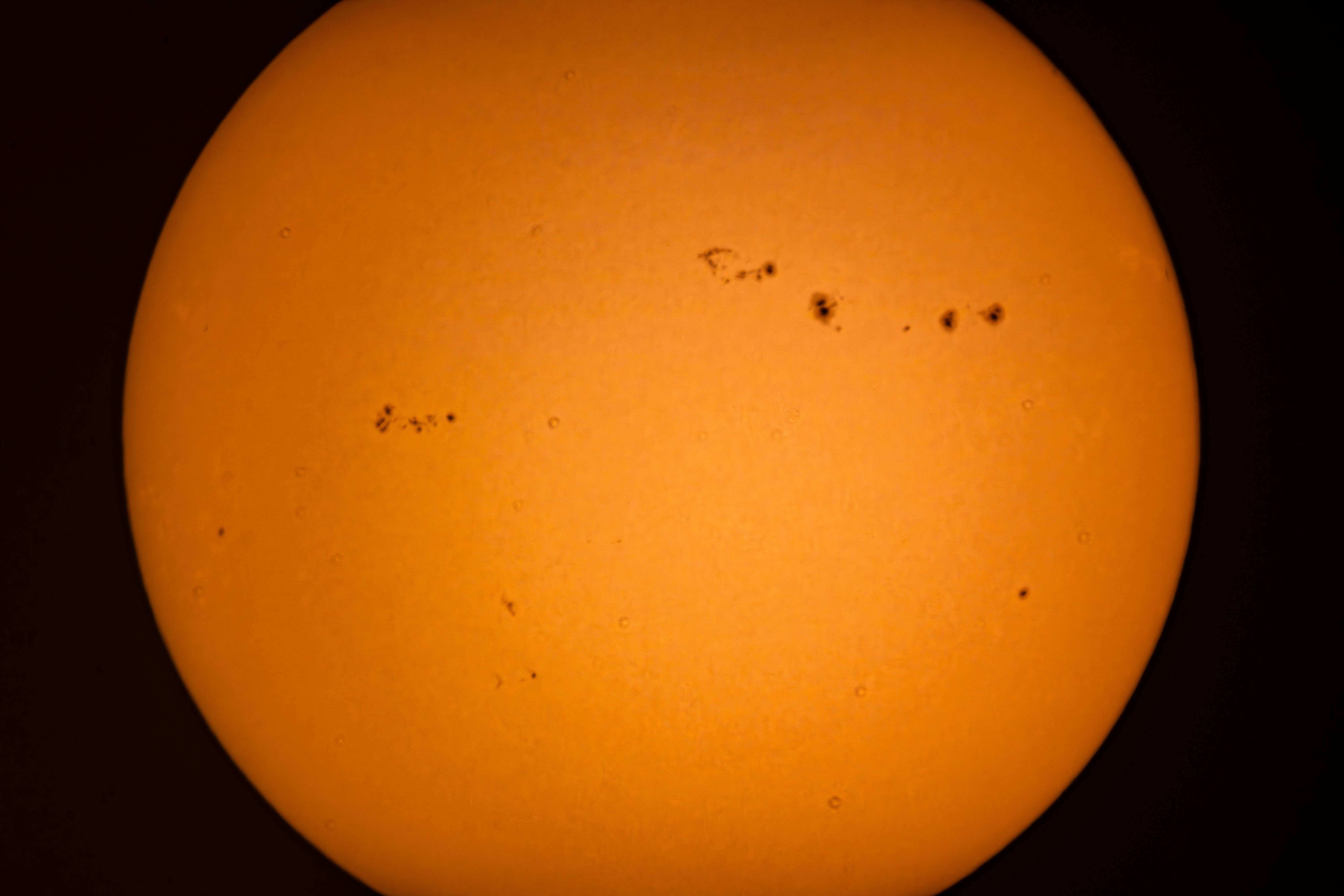
Solar Maximum: A Long-Aired Portrait of the Sun’s 11-Year Dance
The Sun is not a static orb but a turbulent, living system whose surface and atmosphere pulse with magnetic energy. For two years, an amateur astronomer took on the most exacting of tasks: to photograph the Sun with enough steadiness, patience and technical care to stitch together a single composite that traces the solar cycle through the visible story of sunspot groups. The result is not merely an image—it’s a narrative in light and shadow, a time capsule of a star in motion. This is how such an undertaking can illuminate both the science behind solar activity and the practical craft of high-precision astrophotography.
Why the Sun’s surface matters—and why sunspots matter more than you might think
Sunspots are not cosmetic blemishes on a celestial body; they are tangible markers of the Sun’s magnetic personality. They appear where magnetic fields surge to the surface, suppressing convection, cooling the photosphere slightly, and often heralding dynamic events in the solar atmosphere—flares, coronal mass ejections, and auroral displays on Earth. The sunspot cycle, roughly 11 years from solar minimum to maximum and back again, is a barrel-roll of magnetic polarity, plasma motion, and energy release that has real consequences for our technology-dependent society.
Observing sunspots over an extended period yields several insights:
– The cycle is not uniform in time or intensity. Some maxima are abrupt and short; others are protracted and uneven.
– Each sunspot group has its own life arc: emergence, growth, fragmentation, migration toward mid-latitudes, and decay.
– The global balance of magnetic polarities shifts as the cycle progresses, encoding a rich history in the Sun’s surface features.
This is not only about the science of the Sun; it is about how long-term human observation can reveal patterns that short-term snapshots cannot. The composite image becomes a map of that pattern, a single frame that invites the viewer to imagine the rhythm underneath.
From gear to discipline: what it takes to build a solar time-lapse collage
The technical feat behind a multi-year solar composite is as important as the science. The photographer’s toolkit becomes the instrument of a broader discipline—signal processing, calibration, and careful data management. A few focal points stand out:
1) Reliable, safe solar imaging
– Filtration and protection: Solar imaging requires precise, safely filtered optics. The objective is to deliver sharp micro-details without risking the eye or the camera sensor—an essential discipline for anyone who has stood at the telescope’s eyepiece.
– Aerobic stability: The Sun’s disc is bright, and its appearance changes with seeing conditions, air currents, and instrumental drift. Stabilizing exposure, color balance, and frame timing across sessions is a prerequisite to a trustworthy composite.
2) A workflow that preserves fidelity
– Consistent imaging geometry: To stitch years of images, each frame must be aligned with reference to solar coordinates. This requires careful calibration of the field of view, telescope focal length, and image scale.
– Uniform processing: A composite benefits from a consistent approach to de-focusing, sharpening, and contrast, so the final image reflects true solar features rather than processing artifacts.
– Time tagging and metadata: Recording the date, time, solar coordinates, and instrument settings for every frame creates a usable archive for future study or reprocessing.
3) The art of layering
– Layering sunspot groups over time is not simply a collage; it is a chronological cartography. Each group enters the solar disk, evolves, and departs. The compositor’s challenge is to render these trajectories in a way that respects both temporal sequence and spatial continuity.
– Color and tonal decisions: Depending on the capture method, the artist may choose grayscale, false color, or filtered channels to maximize visibility of magnetic structures, penumbral detail, or chromospheric features. Balancing these choices with scientific integrity requires informed interpretation.
A closer look at the image: what a “composite solar maximum” reveals
- The sunspot anatomy lives in the arc: Larger groups, such as AR3664 (which has particular historical associations with auroral activity in May 2024), AR4079 (the largest of 2025), and AR4274 (linked to a recent auroral display), emerge as dominant landmarks within the composite. Their presence is not merely aesthetic; it speaks to the magnetic energy condensed within those active regions.
- The cadence of emergence mirrors solar rotation and subsurface dynamo processes. Active regions appear at mid-latitudes as the cycle waxes, drift toward the equator and toward solar maximum, and decay over weeks to months. The composite captures this migration and attenuation, offering a visual chronicle of a living system.
- The auroral connection grounds the image in planetary-scale effects. When Earth’s magnetosphere is disturbed by a coronal mass ejection associated with sunspot activity, auroras brighten high-latitude skies. The photographer’s reference to auroral events is more than trivia; it anchors solar surface events to their far-reaching consequences.
Interpreting the 2024–2025 solar maximum in a broader context
The solar cycle’s amplitude and timing have practical implications for space weather forecasting, satellite operations, aviation routes, and even power grids. The 2024–2025 window, as observed in this composite, adds to a growing corpus of evidence that the Sun’s magnetic cycle remains a potent driver of terrestrial conditions. For scientists and enthusiasts alike, the image serves as a visual dataset—an invitation to correlate sunspot morphology with magnetic polarity, to compare this cycle with previous maxima, and to consider how cycle variability might inform predictive models.
Beyond the science, there is a pedagogical value. A single composite image distills a decade into a frame, enabling educators to discuss the lifecycle of sunspots, the methods of solar observation, and the relationship between solar physics and Earth’s space environment. For citizen scientists, it demonstrates that meaningful contributions to solar astronomy are possible with rigorous technique, accessible equipment, and a disciplined approach to data continuity.
From hobby to discipline: learning from the craft
The undertaking demonstrates how patient, methodical practice can yield results that stand up to scrutiny from the scientific community. It is a reminder that high-quality solar imaging is not exclusive to institutions with access to top-tier observatories. The confluence of modestly sized telescopes, reliable cameras, and careful data handling can produce work with both aesthetic and analytic value.
Key practical takeaways for aspiring solar imagers:
– Start with safety and calibration. Protect your equipment and your observers with appropriate filtration and shielded optical paths.
– Maintain a consistent imaging regimen. Regular cadence—daily, weekly, or monthly—helps ensure you capture the cycle’s true progression rather than a patchwork of sporadic images.
– Build a metadata-rich archive. Time-stamped, instrument-parameter-laden datasets are invaluable for later stitching and analysis.
– Develop a transparent processing workflow. Document steps for color balancing, noise reduction, and alignment so others can reproduce or extend your work.
What this piece contributes to the conversation about solar observation
This composite does more than celebrate a personal milestone; it reframes how we think about long-term observational projects. The Sun’s activity is often discussed in abstract terms—sunspot counts, 11-year cycles, and space weather alerts. A tangible, artfully constructed image that stitches all major sunspot groups over two years makes the process concrete, invites curiosity, and invites reflection on how scientists and enthusiasts collaborate across time to reveal nature’s patterns.
In terms of future directions, the field is ripe for combining high-resolution solar imaging with quantitative magnetic field measurements. Advances in detector technology, adaptive optics for solar telescopes, and machine-learning tools for feature recognition could enable even more precise temporal stitching, perhaps yielding dynamic “movies” that preserve both spatial fidelity and temporal cadence without sacrificing scientific interpretability. There is also a growing opportunity to integrate such composites with public data portals, making them accessible teaching aids and citizen-science resources.
Concluding reflection: a portrait that invites ongoing observation
The Solar Maximum composite is more than a moment in time captured in pixels; it is an invitation to watch the Sun in a more mindful, sustained way. It prompts questions: How do sunspot groups form and dissolve? How does the magnetic polarity shift across cycles? What patterns emerge when we align surface features with deeper solar interior dynamics?
The craft demonstrated—cool, careful, and communicative—offers both a blueprint and an inspirational example for anyone who would turn long-term observation into meaningful, shareable knowledge. As our technology and our curiosity evolve, so too does our capacity to translate the Sun’s complex, magnetic life into imagery that educates, inspires, and informs our own navigations under its ever-present gaze.