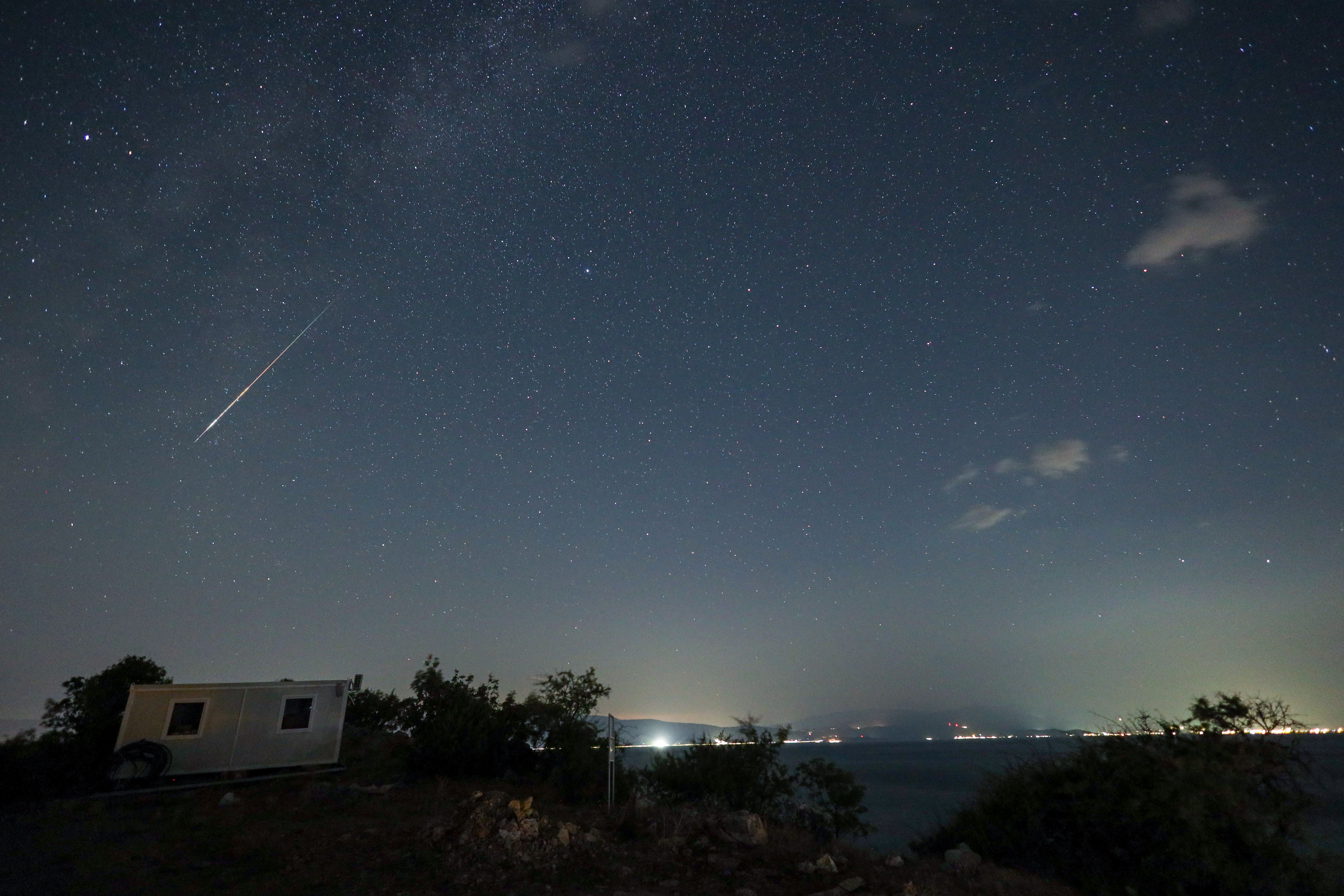
A Green Fireball over the Milky Way: Reading a Moment of Celestial Drama from Molunat
In the stillness of a late-summer night, a streak of light can rewrite our sense of scale. The image described—an exceptionally bright Perseid meteor arcing across the Milky Way from Molunat, Croatia—is not merely a pretty photograph. It is a carefully calibrated encounter between human observation, technological capability, and the age-old human impulse to record wonder. This article uses that single frame as a doorway into the science, craft, and cultural resonance of meteor photography, and why nights like these matter for both enthusiasts and serious scholars alike.
A moment that feels almost out of reach, made accessible through patient technique
The Perseids have long been one of the most reliable meteor showers for observers in the Northern Hemisphere. They originate from comet 109P/Swift-Tuttle, which leaves a trail of debris in its wake. As Earth plows through this debris, each particle enters our atmosphere at high speed, usually burning up around 70 to 100 kilometers per second. The result is a meteor—an incandescent messenger that briefly writes its own line upon the sky. The photographed event in Molunat stands out not simply for speed, but for the vivid green hue and the lingering trail that persists for dozens of frames after the meteor has passed.
Photographic craft meets celestial storytelling
What makes this particular capture compelling goes beyond the meteor’s instantaneous brilliance. The choice of equipment and settings reveals a thoughtful balance between sensitivity, depth, and timing:
- Camera and lens: A Nikon Z6 paired with a wide, fast prime (Nikkor Z 24mm f/1.8 S) is well suited for low-light astrophotography. The lens choice prioritizes a wide field of view to catch sweeping star fields and the Milky Way’s band, while maintaining enough edge-to-edge sharpness to render the meteor’s trail against the galaxy’s structure.
- Exposure and sensitivity: 15-second frames at f/1.8 and ISO 5000. This combination is high enough to reveal the faint glow of the Milky Way and a meteor’s luminous train, while the relatively short exposure minimizes star trailing and keeps the Milky Way’s intricate dust lanes crisp. The result is a crisp juxtaposition: a bright, fast-moving event crossing a relatively static, richly textured backdrop.
- Dark-sky context: Bortle 3.5–4 indicates a substantial degree of light pollution but still decent access to a dark sky. Molunat’s coastal location on the Adriatic helps provide a luminous but not overpowering background, allowing the meteor’s brightness to punch through without washing out the Milky Way’s features.
The science in a single frame
Several scientific strands converge in this image:
- Meteor physics: The bright green color often signals the presence of magnesium in the meteoroid, though color can be influenced by the meteoroid’s speed, composition, and the surrounding atmospheric chemistry. The smoke/dust tail visible after the meteor’s disappearance complicates the traditional simplification of meteors as brief, singular flashes; it indicates a denser departure of material along the trajectory, potentially from ablation processes that leave residual particulates glowing before dispersal.
- Trail persistence: A lingering trail across approximately 40 frames suggests the photographer captured a combination of a retained ablation plume and a post-flare luminous wake. In practical terms, it offers a real-time visual demonstration of how meteor material interacts with the upper atmosphere and then slowly disperses.
- Milky Way as a foil: The Milky Way is not just a backdrop; it serves as a complex, high-contrast field that reveals how fleeting phenomena integrate with stable astronomical structures. The juxtaposition underscores the difference between transient sky events and the deep-sky architecture that has endured for millions of years.
A moment of human geography: Molunat and the culture of stargazing
Molunat, a village perched on Croatia’s Dalmatian coast, represents more than a photograph locale. Its position relative to the Adriatic horizon provides a near-transparent canvas for nocturnal skies when local weather cooperates. The photograph embodies a contemporary form of travel and science communication: intrepid night-sky hunters who weave together location, timing, and gear to produce images that can travel around the world via online platforms. The story here is twofold—first, the meteor provides a direct line to a celestial event; second, the image stands as evidence of how modern amateur astronomy can translate into shareable, educational, and aesthetically compelling content.
Technical considerations that guide the craft
For readers who aspire to reproduce or interpret this kind of work, several practical takeaways emerge:
- Planning around the Perseids: The Perseids peak in mid-August, but favorable conditions—dark skies, a clear horizon, and minimal moonlight—are essential. In this case, the photographer achieved a balance of meteor frequency and light pollution that allowed a bright fireball to stand out against the Milky Way.
- Sensor and workflow decisions: Shooting continuously over a night, with high-ISO captures, requires a careful balance between noise management and frame rate. Post-processing with Lightroom and Photoshop is not merely about cleaning up noise; it is about preserving the meteor’s color fidelity, highlighting the smoke trail, and maintaining the Milky Way’s structural integrity without introducing halo artifacts or over-sharpening.
- Ethical and practical constraints: Long-exposure night photography can impact local ecosystems and the nightscape’s enjoyment by others. Responsible practices—minimizing intrusion into natural environments, respecting local regulations regarding nocturnal illumination, and leaving no trace—are essential corollaries to the craft.
Beyond the single image: what this kind of photography invites us to consider
- The temporality of the night sky: A meteor is a flash of time that compels us to confront the universe’s vast timescales. The photograph captures a moment that will never occur again in exactly the same way, reminding us of the fragility and preciousness of observational opportunities.
- The intersection of art and measurement: The image sits at a crossroads where aesthetic composition meets empirical signal. The color, brightness, and trajectory convey information about composition and dynamics, even as they serve as a form of visual poetry.
- The social dynamic of amateur science: Shared images democratize access to rare events. They enable a corridor of citizen science—observations, metadata reporting, and collaboration with astronomy communities—while also enriching public understanding of meteor phenomena and cosmic debris.
What to take away: actionable wisdom for enthusiasts and practitioners
- Invest in wide-field gear that supports both landscape framing and transient events. A fast 24mm lens provides the expansive sky seen in this image, crucial for capturing the Milky Way’s band in context with a meteor.
- Practice disciplined capture strategies. A balance between exposure length and cadence—15 seconds in this case—offers a practical template: enough time to register stars and the galaxy, but short enough to freeze the meteor’s motion while keeping trails legible.
- Develop a robust post-processing workflow that respects reality. Color grading should reflect the meteor’s natural hue while avoiding the temptation to oversaturate. Trail enhancement should be subtle enough to preserve its ephemeral character without producing artificial glow.
- Honour the night environment. Seek out dark-sky locations, monitor local light pollution trends, and follow guidelines for responsible nocturnal photography to protect visibility for future observers.
Contextualising the scene in the broader arc of modern astrophotography
The convergence of accessible high-quality cameras, rapid autofocus systems, and wide, fast lenses has transformed what once required a team of specialists into something individual photographers can pursue with relative independence. This democratization is a double-edged sword. It expands the pool of observers, but it also raises the bar for what counts as credible, responsibly produced astrophotography. The Molunat image stands as a model for how to navigate this landscape: technical competence married to a reverent engagement with natural beauty.
Future directions and horizon-scanning for aspiring meteor hunters
- Automation and AI-assisted framing: As camera systems become smarter, there is potential for real-time meteor detection and dynamic framing algorithms that capture the moment when a fireball bursts into view, optimizing exposure settings on the fly.
- Spectral analysis through simple means: While complex spectroscopy requires specialized equipment, photographers can experiment with filters to isolate atmospheric emissions, potentially revealing more about meteoroid composition through color shifts in the wake.
- Community-driven datasets: A global corpus of meteor captures, cross-referenced with meteor shower predictions and atmospheric conditions, could yield richer statistical insights into fireball frequency, brightness distributions, and trail persistence, benefiting both science and public outreach.
Concluding reflection: why this matters
This image from Molunat embodies a broader human endeavour: to translate fleeting, ineffable phenomena into something tangible, shareable, and instructive. In an age where the night sky is increasingly a shared resource—threatened by light pollution, climate change, and the fragmentation of leisure time—the chance to witness, and to document, a bright green Perseid crossing the Milky Way is more than a moment of beauty. It is a reminder that the universe remains legible to those who prepare, observe, and persist. The photograph is not only a testament to skill and luck; it is an invitation to look upward with curiosity, patience, and reverence for the tumultuous, luminous chemistry of our celestial sidewalk—where a single fireball can illuminate the path between wonder and understanding.