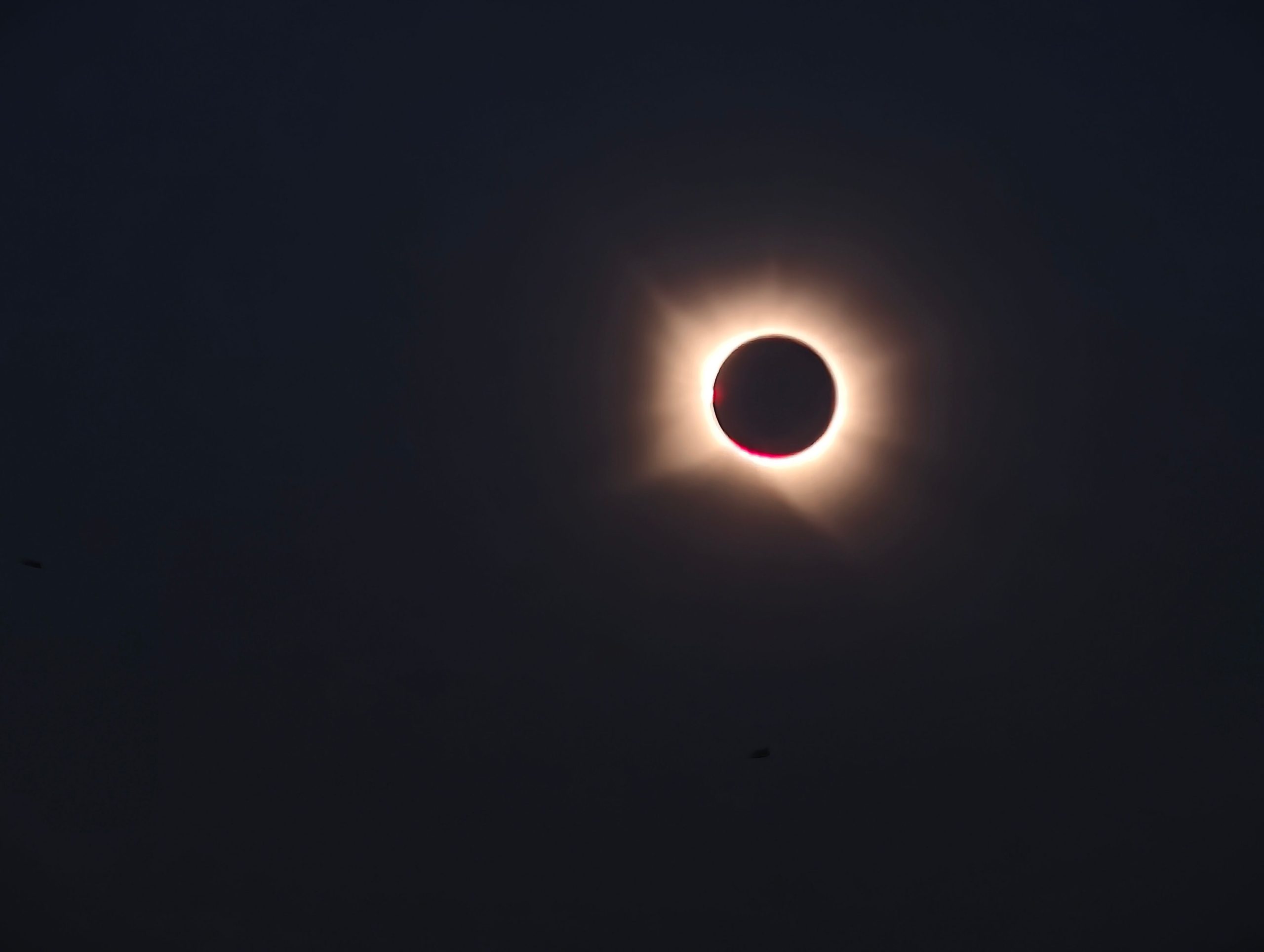
Capturing the Sun’s Corona During the August 12 Total Solar Eclipse: An HDR Perspective
Solar eclipses offer a rare opportunity to observe and photograph the Sun in a state typically hidden from view. One of the most captivating features revealed during totality is the Sun’s corona—the shimmering halo of plasma extending millions of kilometers into space. Due to its extremely faint nature, the corona is nearly impossible to photograph under normal conditions, as the brightness of the Sun’s photosphere drowns out these delicate structures. However, during a total eclipse, the Moon’s shadow creates the perfect conditions to view and capture this elusive feature.
In a recent observation during the August 12 total solar eclipse, I employed a technique that combines images captured at different exposures to produce a high dynamic range (HDR) visualization of the Sun’s corona and surface features. This approach involves blending a picture taken moments before first contact, which captures the Sun’s bright photosphere, with a high-exposure image during totality that reveals the corona and chromosphere in exquisite detail.
Understanding the Challenge
The stark disparity in brightness between the Sun’s surface and its corona—approximately a factor of one million—presents a significant challenge for astrophotography. Standard cameras and imaging techniques are often inadequate to simultaneously capture both features without either overexposing the surface or underexposing the corona. The solution lies in high dynamic range imaging, which involves merging multiple exposures to retain detail across the entire brightness spectrum.
Equipment and Methodology
To achieve this, I used a combination of professional astrophotography gear:
- Canon 6D Mark II DSLR camera
- Sigma 150-600mm telephoto lens
- Lunt LS50Tha solar hydrogen-alpha filter
- ZWO ASI174MM monochrome camera
- Celestron X-Cel 2x Barlow lens
These tools allowed me to capture both wide-field and solar-specific images with precision. I first took an image of the Sun just before totality to record the photosphere in its natural brightness. During the total eclipse, I captured high-exposure images emphasizing the corona and chromosphere. Using image processing software, I then combined these exposures to generate an ultrahigh dynamic range visualization, revealing the Sun’s surface and corona in unprecedented detail.
Final Thoughts
This approach underscores the extraordinary beauty and complexity of our star’s outer atmosphere. Total solar eclipses provide invaluable opportunities for both scientific study and visual appreciation. By employing HDR imaging techniques, photographers and astronomers can uncover new perspectives and appreciate the intricate structures surrounding the Sun during these celestial events.
Interested in solar astrophotography? With the right gear and techniques, you too can capture stunning images of our star in its ephemeral totality.